

Course Information
ART
Follow us on Instagram for daily update @stepneyallsaints_adt
Fine Art AS Level will enable students to explore and investigate a range of concepts, artists and creative approaches. Students will experiment with a variety of techniques, processes and materials.

Overview
A brief introduction to the subject:
- AS Level Art This WJEC Eduqas AS Art and Design specification has been designed to provide engaging and innovative creative learning experiences, where art, craft and design practice is meaningfully integrated with theoretical knowledge and understanding.
- The specification encourages creativity, sustained investigation and analysis, experimentation, and design and making as a means of developing technical and expressive skills. It gives learners the opportunity to follow a programme of study which extends experience and personal response as well as developing imagination and critical and reflective thinking. The ability to innovate, adapt and work independently, which underlies all aspects of the specification, is valued by higher education and employers alike.
- This AS specification aims to encourage learners to develop: • intellectual, imaginative, creative and intuitive capabilities • investigative, analytical, experimental, practical, technical and expressive skills, aesthetic understanding and critical judgement • independence of mind in developing, refining and communicating their own ideas, their own intentions and their own personal outcomes • an interest in, enthusiasm for and enjoyment of art, craft and design • the experience of working with a broad range of media • an understanding of the interrelationships between art, craft and design processes and an awareness of the contexts in which they operate • knowledge and experience of real world contexts and, where appropriate, links to the creative industries • knowledge and understanding of art, craft, design and media and technologies in contemporary and past societies and cultures • an awareness of different roles, functions, audiences and consumers of art, craft and design.
- Students will enjoy studying Fine Art if they enjoy: drawing or recording using photography, discussing their ideas, using their imagination and problem solving.
Entry Requirements
- Minimum entry requirement at least a grade 4 in any Art and Design GCSE such as: photography, textiles, graphics, art craft and design, fine art, three dimensional design or photography.
- Prior knowledge of formal elements in Art and Design, documenting and maintaining a sketchbook and the ability to discuss your motivation behind your work.
- The AS Level Fine Art places an emphasis on drawing. Students should be confident in drawing in any of the following ways: sketches, analytical observational studies, storyboarding, thumbnail sketches, layouts, roughs, experimental and expressive studies, 2D or 3D modelling, detailed designs or elevations. Drawing or recording can also be conducted via the use of digital tools such as a stylus and software programme, or traditional media such as charcoal or pen. Drawing can similarly be highly effective when digital tools and technologies are integrated with more traditional processes.
Course Content
Year 12 (AS )
- The Personal Creative Enquiry consists of an extended, exploratory project/portfolio and outcome/s based on themes and subject matter which are personal and meaningful to the learner. The Enquiry must integrate critical, practical and theoretical work.
- The learner will be required to select, evaluate and present work for assessment. Submissions will be assessed through the use of the assessment objectives. Work will be determined by the learner and teacher, assessed by the teacher and externally moderated.
- The extended personal creative enquiry will be based around the theme ‘Memory, Traces and time’. Students will be introduced to various ways of making art, techniques, specialist materials and contemporary artists work.
- Learning activities will consist of: art workshops, Gallery Visits, studio based learning, written contextual analysis of artists and their art and group discussions (critiques).
- Students will be regularly given feedback on their creative enquiry through one to one tutorials with their teacher. Students will regularly be marked using the exam board Eduqas’ marking matrix.
- Coursework is worth 100% of the student’s final AS Level grade (A-E).
Skills Gained
By the end of the course, students will develop:
- Analytical / problem-solving skills.
- The ability to communicate their ideas and thought process through their creative enquiries both verbally and via written communication and sketchbook analysis.
- Critical thinking.
- The ability to create and respond to a range of different media, artists and art movements via practical art-making.
- Independent study and research.
- The ability to produce a sustained visual outcome working to time restrictions.
Future Opportunities
Studying AS Fine Art can lead to an extensive range of university courses. Such as: Architecture, Interior design, Fine Art, Photography, Graphic Design, Illustration, Set Design, Media studies, History of Art, game art and animation, ceramics, art therapy, fashion design, digital communication, web design and development, product design, textiles, textiles conservation, fashion communication, decorative arts and historic interiors, curation, costume design and making, sustainable fashion, automotive and transport design, concept and comic arts, creative advertising, fashion buying and merchandising, digital design and media, secondary school art , primary school education and more.
- Art has an extensive list of career pathways including: teaching, advertising, design, museum curation, fashion, animation, gaming and architecture.
- Fine Art will give you the transferable skills of: working to a deadline, problem solving, communicating with others, organisation, working as a group and independently, responding to ideas and expressing yourself.
Enrichment Opportunities
- In AS Art, we use the rich resources of London’s galleries and museums to give momentum and inspiration to our projects. We will be attending these institutes throughout our studies.
- All Art students are encouraged to attend galleries and make the most of the Tate Collective opportunity for discounted entry into paid exhibitions. Details can be found here https://www.tate.org.uk/tate-collective
- Alternatively, the Royal Academy runs a ‘young people’ discounted programme showcasing exhibitions and workshops. For more information please visit this site https://www.royalacademy.org.uk/page/young-people-programme.
- Reading List: ‘Playing to the gallery’ Grayson Perry, ‘Ways of seeing’ John Berger, ‘Steal like an artist’ Austin Kleon, ‘The Art book revised edition’ Phaidon.
Subject Leader
Name: Ms Clare Dorber
Email: clare.dorber@stepneyallsaints.school
BUSINESS

Business Studies – A Level
Qualifications to start the course
Minimum entry requirements for all A-Level courses are a minimum of 8 GCSE subjects, with an average grade of 6 (legacy grade B) or above, including at least a grade 6 or above in GCSE English Language (or Literature) and GCSE mathematics and a grade 6 or above in GCSE Science.
To study this subject, you will also need a grade 6 or above in GCSE English Language.
Description of the subject
This course is particularly suitable for any student with an enquiring and analytical mind who takes a keen interest in the way the wider economy and the dynamic business world operates.
Students will develop the knowledge and skills needed to analyse data, think critically about issues and make informed decisions – all skills that are needed for further study and employment. You will study business in a variety of contexts (e.g. large/ small; UK/global; service/manufacturing) and consider:
- The importance of the context of business in relation to decision making
- The interrelated nature of business activities and how they affect competitiveness
- The competitive environment and the markets in which businesses operate
- The influences on functional decisions and plans including ethical and environmental influences
- The factors that might determine whether a decision is successful (e.g. quality of data and degree of uncertainty)
- How technology is changing the way decisions are made and how businesses operate and compete
- The impact of stakeholders of functional decisions and their response to such decisions
- Use of non-qualitative and quantitative data in decision making (including interpretation of index numbers and calculations such as ratios and percentages)
What you will do
| Paper 1: Business 1 | + | Paper 2: Business 2 |
| What’s assessed
1-6 and above |
What’s assessed
1-6 and above |
|
Assessed
|
Assessed
|
|
| Questions
Three compulsory sections:
|
Questions
One compulsory case study consisting of approximately seven questions |
| Paper 1: Business 1 | + | Paper 2: Business 2 | + | Paper 3: Business 3 |
| What’s assessed
All content above |
What’s assessed
All content above |
What’s assessed
All content above |
||
Assessed
|
Assessed
|
Assessed
|
||
| Questions
Three compulsory sections:
|
Questions
Three data response compulsory questions worth approximately 33 marks each and made up of three or four part questions. |
Questions
One compulsory case study followed by approximately six questions |
Before the qualification can be awarded, students must undertake all of the assessments above.
/i/video/Year-11-Options_pptx-Google-Slides.mp4
Future prospects
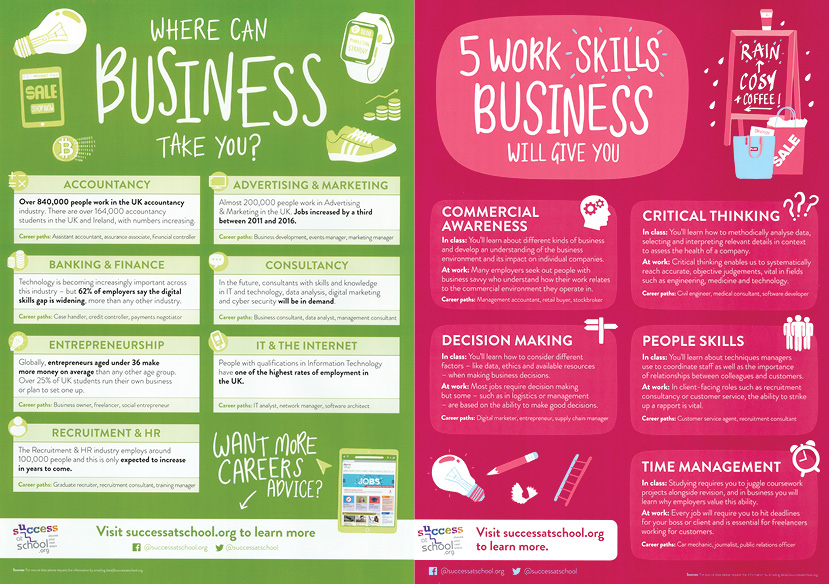
Careers in Business (Marketing, Operations, Finance or Human Resources) and the opportunity to set up your own small private enterprise.
Business Studies - BTEC Level 3
Qualifications to start the course
Students must have five GCSEs including English, Mathematics and Science graded A* – C.
Description of the subject
This is a vocationally related qualification. It provides knowledge of business activity and helps to develop skills commonly required in business organisations. Students will complete 13 units over two years. The qualification is equivalent to three A Levels, at A – C therefore successful students will obtain a triple award (e.g. PPP, MMM, DDD, DDD*).
What you will do
This course consists of 13 units in total and is equivalent to three A-levels. Grading system is Pass, Merit, and Distinction; there are 7 mandatory units and 6 optional.
Mandatory units are as follows (*= exam assessed units):
- Exploring Business
- Developing a Marketing Campaign*
- Personal and Business Finance*
- Managing an Event
- International Business
- Principles of Management*
- Business Decision Making (synoptic)*
Optional units:
- Recruitment and selection process
- Team building in Business
- Investigating Customer Service
- Creative Promotion
- Pitching for a new Business
- Market Research
Future prospects
Higher Education in business or management.
Accountancy, Business Finance, Law, Retail. There are many organisations seeking to employ people with business knowledge and skills. Insight into setting up your own small private enterprise.
COMPUTER SCIENCE
/i/video/A-Level-computing-compressed.mp4
Computer Science – A Level
Entry Requirements:
Minimum entry requirements for all A Level courses are minimum of 8 GCSE subjects, with an average grade of 6 (legacy grade B) or above; including at least a grade 6 or above in GCSE English Language (or Literature) and GCSE mathematics and a grade 6 or above in GCSE Science.
In addition, to study this subject you must have a grade 5 or above in mathematics and English Language. 6 or above in GCSE Information Technology/BTEC equivalent at distinction.
Overview:
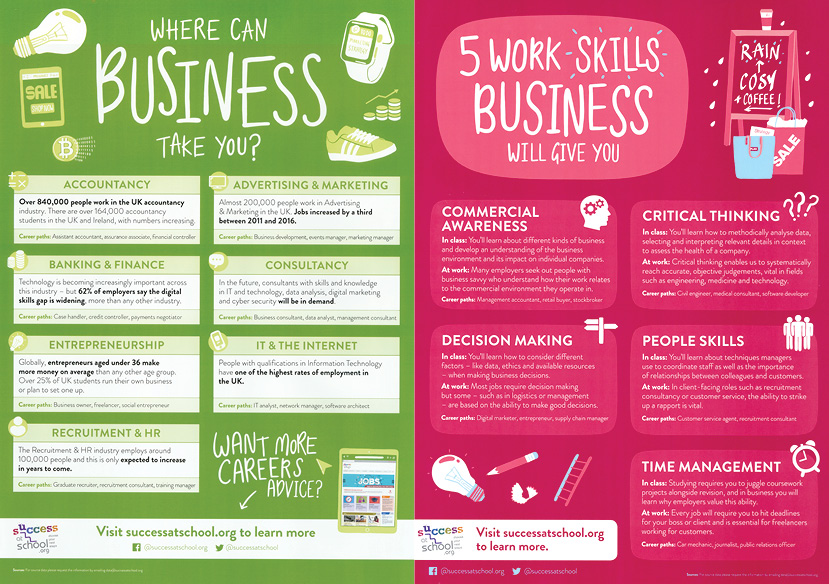
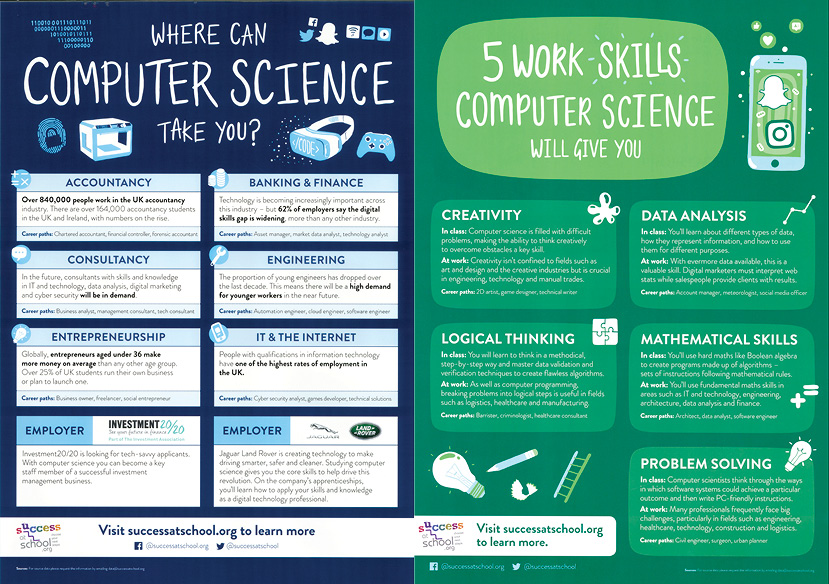
Computer Science is a practical subject where students can apply the academic principles learned in the classroom to real-world systems. It’s an intensely creative subject that combines invention and excitement, and can look at the natural world through a digital prism.
The aims of this qualification are to enable learners to develop:
An understanding and ability to apply the fundamental principles and concepts of computer science, including: abstraction, decomposition, logic, algorithms and data representation
- The ability to analyse problems in computational terms through practical experience of solving such problems, including writing programs to do so
- The capacity to think creatively, innovatively, analytically, logically and critically
- The capacity to see relationships between different aspects of computer science
- Mathematical skills.
Year 1 and 2 units:
1. Unit name: Unit 1 – Component 1
Unit Title: Computing principles
Exam Type: Written paper – 1 hour and 15 minutes
Marks: 140 marks 40% of A level
2. Unit name: Unit 2 – Component 2
Unit Title: Algorithms and problem solving
Exam Type: Written paper – 1 hour and 15 minutes
Marks: 140 marks 40% of A level
3. Unit name: Unit 3* or 4** – Component 3 or 4
Unit Title: Programming project
Exam Type: Written paper – 1 hour and 15 minutes
Marks: 70 marks 20% of A level
* Indicates synoptic assessment
** Learners who are re-taking the qualification may carry forward their mark for the non exam assessment component (04).
IT Practitioners – BTEC
BTEC Level 3 National Extended Diploma in Computing
Overview:
BTEC Level 3 is a triple course consisting of 13 units. 4 units are externally assessed and 9 units are internally assessed. This course is equivalent to 3 A-levels (1080 guided learning hours)
Year 12
Unit 1- Principles of Computer Science
Unit 2 – Fundamentals of Computer Systems
Unit 3 – Planning and Management of Computer Systems
Unit 4 – Software Design and Development Project
Unit 8 -Business Application of Social Media
Unit 10 -Human-computer Interaction
Unit 15 – Website Development
Unit 14 – Computer Games Development
Year 13
Unit 7 – IT System Security and Encryption
Unit 9 – The Impact of Computing
Unit 18 – Relational Database Development
Unit 22 – Systems Analysis and Design
Unit 19 – Computer Networking
ENGLISH
English Literature
Minimum entry requirements for all A Level courses are minimum of 8 GCSE subjects, with an average grade of 6 (legacy grade B) or above; including at least a grade 6 or above in GCSE English Language (or Literature) and GCSE mathematics and a grade 6 or above in GCSE Science.
In addition, to study this subject you must have a grade 6 or above in GCSE English Language and Literature.
//www.loom.com/embed/619b761b477c4c8b9379d212cb341cc1#t=0.5
Description of the subject
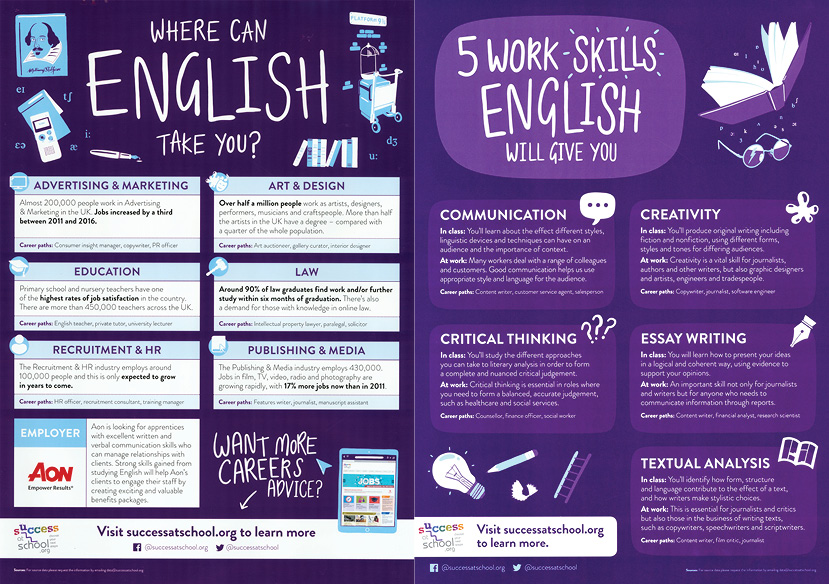
English Literature builds on skills already developed at GCSE. Students cover a range of texts from across genres and time periods, drawing comparisons and analysing ideas and themes in depth. There is a lot of emphasis placed on reading, both for the course and for pleasure.
Throughout the course the focus is on analysing the ways in which stories are told and thereby constructing different realities; a significant element to this is understanding the context in which texts are produced and thinking about the ways in which we understand them as readers.
Assessment of this subject at AS-Level consists of 2 terminal papers. Assessment of this subject at A-Level consists of 3 terminal papers and one piece of coursework.
Wha
- Read challenging literary texts from a range of genres and time periods.
- Make connections across texts by exploring their themes and ideas.
- Analyse linguistic devices and the effects they create.
- Engage with a variety of critical perspectives and develop your own critical voice.
- Critically engage with texts, sharing ideas in class discussion.
- Develop independent reading and research skills.
Future prospects
English Literature is a great foundation for any humanities subject at university (including English, History, Law, Politics, Philosophy, Media Studies, Languages or Social Science) as it helps students engage with a wide range of material and teaches invaluable independent research and analytical skills.
Media Studies
/i/video/Media_Alevel_Presentation_for_Y11.mp4
Qualifications to start the course
Minimum entry requirements for all A Level courses are minimum of 8 GCSE subjects, with an average grade of 6 (legacy grade B) or above; including at least a grade 6 or above in GCSE English Language (or Literature) and GCSE mathematics and a grade 6 or above in GCSE Science.
In addition, to study this subject you must have a grade 6 or above in GCSE English Language.
Description of the subject
The Eduqas Media A Level explores media industries, audiences, and representations. Students analyze texts, apply theoretical frameworks, and develop practical production skills across formats (film, TV, digital). Assessment combines written exams and coursework, emphasizing critical evaluation, research, and creativity to understand media’s cultural, social, and economic impact.
What you will do
Students are expected to analyse set media products (including Janelle Monae, Black Panther, Vogue and many more), apply key media theories, and evaluate representation, industry, and audience. They complete independent research, write extended analytical essays in exams, and produce a practical media project with a reflective evaluation demonstrating creative and critical skills.
Future prospects
-
Media-related degrees (e.g., Media Studies, Film, Journalism, Communication, Advertising).
-
Creative & digital careers in film, TV, marketing, social media, publishing, PR, and content production.
-
Roles requiring strong critical thinking, research, and communication skills across industries.
SPORT SCIENCE
BTEC Sport Leve 3 – National Extended Diploma
- Key information:
-The course is worth the equivalent of two or three A levels
-You can either choose to do the course worth two A levels with one other A level subject OR do the course worth three A levels with NO other A levels.
-You are required to get 5 grades 9-4 at GCSE level (including English Language or Literature, Maths and Science.)
-Students who have studied GCSE PE, BTEC PE or Cambridge Nationals in Sport Science or Studies will be prepared well for choosing this course, however it’s possible to do this qualification without having studied PE at KS4.
-The course is mostly coursework, however there is a written exam for the anatomy & physiology unit. Students are also assessed practically in unit 7 – practical sports performance.
-This course is ideal for students who are planning to have a career in the sport and leisure industry.
- Externally assessed units (triple BTEC course)
Unit 1 – Anatomy & Physiology (written exam)
Unit 2 – fitness training and programming for health, sport and well-being
Unit 19 – Development and provision of sport and physical activity
Unit 22 – Investigating business in sport and the active leisure industry
- Internally assessed units (triple BTEC course):
Unit 3 – Professional development in the sports industry
Unit 4 – Sports leadership
Unit 5 – Application of fitness testing
Unit 6 – Sports Psychology
Unit 7 – Practical Sport Performance
Unit 8 – Coaching for performance
Unit 9 – Research methods
Unit 10 – Sports event organisation
Unit 23 – Skill acquisition in sport
Unit 25 – Rules, Regulations and Officiating in Sport
- Externally assessed units (double BTEC course)
Unit 1 – Anatomy & Physiology (written exam)
Unit 2 – fitness training and programming for health, sport and well-being
Unit 22 – Investigating business in sport and the active leisure industry
- Internally assessed units (double BTEC course):
Unit 3 – Professional development in the sports industry
Unit 4 – Sports leadership
Unit 6 – Sports Psychology
Unit 7 – Practical Sport Performance
Unit 8 – Coaching for performance
Unit 23 – Skill acquisition in sport
- Key transferable skills:
-Leadership
-Coaching
-Communication
-Management
-Research
-Writing
-Critical thinking
-Social skills
-Conflict resolution
-Listening
-Creativity
- Future careers:
-Fitness e.g. gym instructor, personal trainer
-Business roles e.g. sports agent, sports journalist
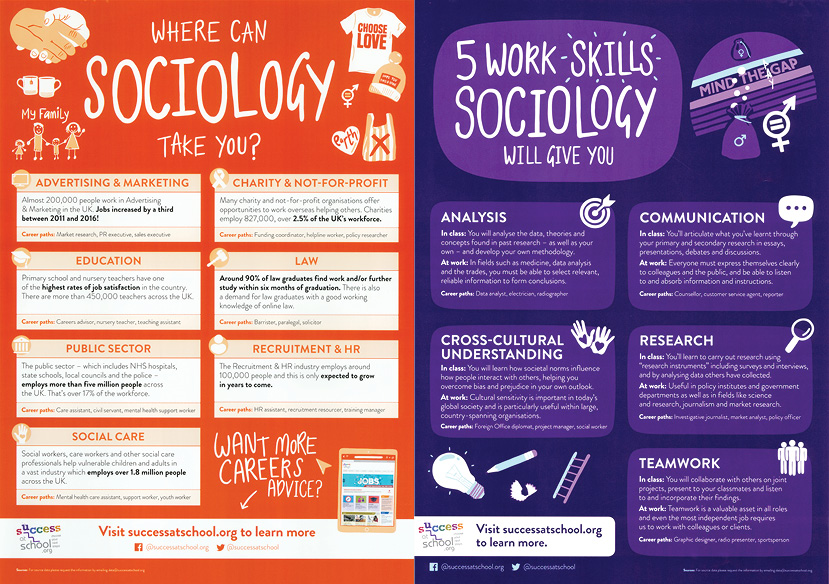
-Outdoor e.g. outdoor activities instructor
-Elite sport e.g. sports nutritionist, physiotherapist
-Coaching e.g. community coach, elite performance coach
-Leisure e.g. swimming teacher, leisure centre manager
-Management roles e.g. gym manager
-Teaching e.g. primary teaching , PE teaching
PERFORMING ARTS
Our A-level Drama and Theatre offers students the opportunity to explore drama as a practical art form, in which ideas and meaning are communicated to an audience through choices of form, style and convention.
/i/video/Theatre-Studies-A-Level.mp4
Qualifications to start the course
Minimum entry requirements for all A Level courses are minimum of 8 GCSE subjects, with an average grade of 6 (legacy grade B) or above; including at least a grade 6 or above in GCSE English Language (or Literature) and GCSE mathematics and a grade 6 or above in GCSE Science.
Drama and Theatre studies builds on skills already developed at GCSE. Although, studying Drama at GCSE would be very beneficial to the course is not essential.
Description of the subject
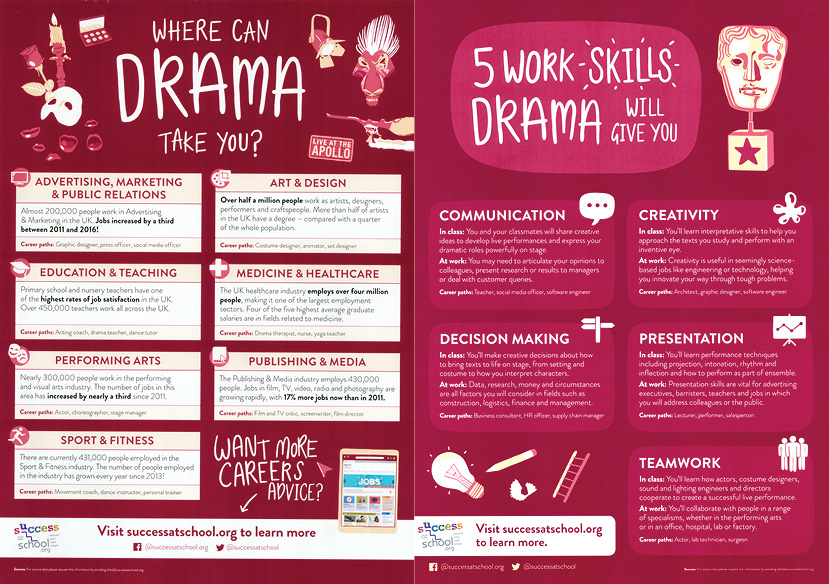
Students cover a range of plays from across genres, drawing comparisons and analysing ideas and themes in depth. There is a lot of emphasis placed on interpretation of plays and the how the directors would realise them for the audience; as well as performing plays, getting under the skin of characters and creating your own original Drama.
Throughout the course, the focus is on analysing the ways in which plays are told and thereby constructing and reimagining different realities; a significant element to this is understanding the social, political, cultural and historical context in which the play are produced and thinking about the ways in which we understand them as an audience.
Assessment of this very enjoyable course consists of 3 examinations
- Devise an original performance piece. Using one key extract from a performance text and a theatre practitioner as stimuli.
- A group performance/design realisation of one key extract from a performance text. A monologue or duologue performance/design realisation from one key extract from a different performance text
- Live theatre evaluation. Practical exploration and study of a complete performance text, focusing on how this can be realised for performance. Practical exploration and interpretation of another complete performance text, in light of a chosen theatre practitioner, focusing on how this text could be reimagined for a contemporary audience.
What you will do
Students will:
- Create, perform and respond to drama and theatre
- Develop the creativity and independence to become effective theatre makers
- Explore the relationship between theory and practice in a range of theatrical styles and periods and historical, social and cultural contexts
- Learn how relevant research, independent thought and analysis of live theatre production can inform decision making in their practical work and put this understanding into practice
- Experience the ways in which theatre makers collaborate to create theatre.
Future prospects
A-level Drama and Theatre is a solid foundation for any subject at university. Top Universities such as Oxford and Cambridge, favour students who have study Drama as they perceive as more rounded academically. On completion of their A Level students will be skilled, confident communicators and excellent critical thinkers and have the ability to view the world from different perspectives .
Theatre Studies is a good course to link up with Art, English Lang and Lit,Psychology, History, Media, Music, Sociology . Careers pathways include Educators, Medicine, Law, Social worker, Theatre industry; Art Administrators, Performers, Directors, Designers, Producers, and more.
Humanities
GEOGRAPHY
//www.loom.com/embed/21fde100608744b3bd6e03d99f1fe334#t=0.5
Qualifications to start the course
Minimum entry requirements for all A Level courses are minimum of 8 GCSE subjects, with an average grade of 6 (legacy grade B) or above; including at least a grade 6 or above in GCSE English Language (or Literature) and GCSE mathematics and a grade 6 or above in GCSE Science.
In addition, to study this subject you must have a grade 6 or above in GCSE Geography.
Description of the subject
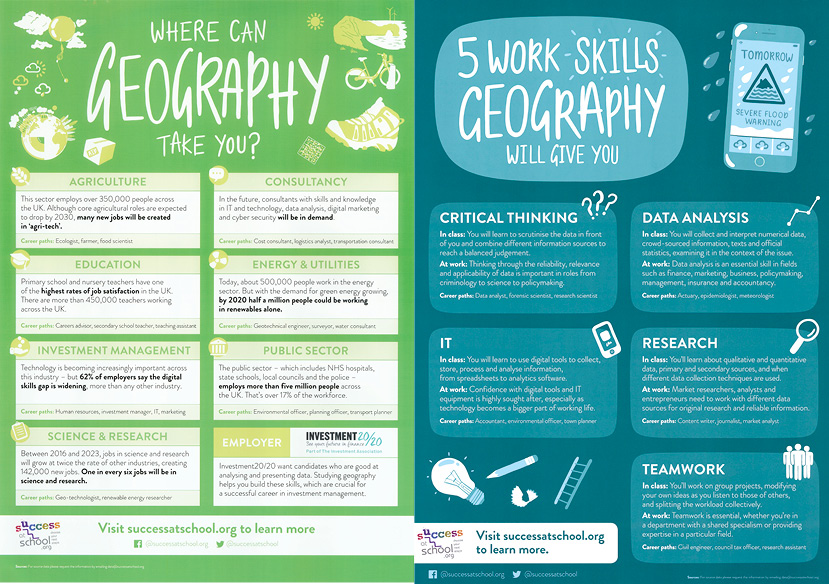
The Geography AS and A2 Level course examines the causes and consequences of some of the headline global issues. Students are given the opportunity to evaluate how successful humans have been in managing the problems that have arisen over recent years. Topics such as global warming, natural disasters, globalisation, superpowers, energy security and poverty are covered.
In addition to this, you will be assessed on your ability to undertake geographical investigations and research. This element of the course includes a field trip and an independent research project.
What you will do
- Investigate a range of local and world issues
- Examine issues in managing the environment and resources
- Assess questions of sustainability, growth, conservation and exploitation
- Learn about forces influencing the environment
- Look at how people, government and economic forces make decisions that impact on the environment
- Field work.
Future prospects
Careers in:
Travel and Tourism, Planning – Housing, Aid Agencies, Local Government, Business, Environmental Agencies, Further Education Sector Organisations.
HISTORY
/i/video/A-Level-History-.mp4
Qualifications to start the course
Minimum entry requirements for all A Level courses are minimum of 8 GCSE subjects, with an average grade of 6 (legacy grade B) or above; including at least a grade 6 or above in GCSE English Language (or Literature) and GCSE mathematics and a grade 6 or above in GCSE Science.
In addition, to study this subject you must have a grade 6 or above in GCSE English Language.
Description of the subject
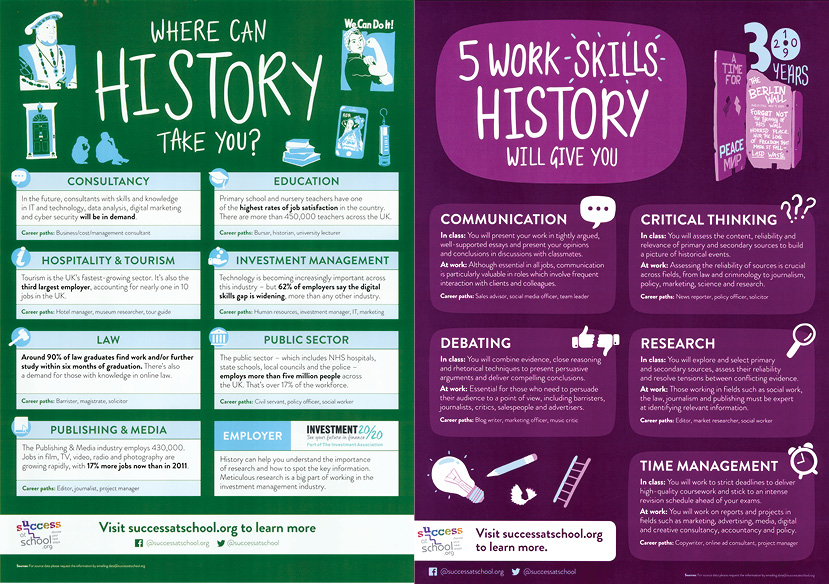
The History course focuses on 20th century political, social and cultural changes. The course develops the students’ oral and literacy skills through the writing of extended essays, oral presentations and discussions.
The course followed is Edexcel Route F. In Year 12, Paper 1 & 2 Searching for rights and freedoms in the 20 century.These papers follow the development of the USA 1918 -1996 and examine thematic changes during this era. Paper 2 is on the Indian Independence Movement 1914-1948. In Year 13 we study the British gaining and losing an empire and the Coursework option examines the causes of and reasons for the end of the Cold War.
What you will do
- Analyse different types of sources and develop your analytical and evaluative skills
- Understand evidence, explanation and change
- Discuss problems and analyse evidence
- Write clear, well-organised explanations and evaluate conflicting interpretations.
Future prospects
- All of these activities make an A Level in History a very useful and much sought after qualification in employment areas such as; Management, Finance, Law, Civil Service and Teaching.
- An A Level in History will help students to prepare for courses /degrees in higher education which may lead to one of the careers above.
RELIGIOUS EDUCATION
/i/video/RE-Video-6th-form.mp4
Course Overview
A Level Religious Studies is a highly academic and intellectually demanding subject that equips students with advanced skills in critical thinking and philosophical analysis. Students explore fundamental questions about existence, morality, knowledge, and belief, while engaging rigorously with both classical and contemporary scholarship.
The subject is particularly well regarded by leading universities. Our students have progressed to University of Oxford, University of Cambridge, London School of Economics, and King’s College London to study Philosophy and related disciplines, reflecting the subject’s strong academic reputation and skills base.
Course Content
Students study three examined components, each worth one third of the qualification.
1. Philosophy of Religion
This component introduces students to some of the most influential debates in Western philosophy, focusing on questions about existence, reason, experience, and meaning.
Topics include:
- Arguments for the existence of God
- Cosmological Argument
- Teleological (Design) Argument
- Ontological Argument
- Challenges to religious belief
- The problem of evil and suffering (logical and evidential)
- Religious experience
- Mystical experiences
- Corporate and individual religious experiences
- Religious language
- Cognitive and non-cognitive language
- Verification and falsification
- Analogy and symbol
- Life after death
- Resurrection
- Immortality of the soul
- Reincarnation
Students engage critically with philosophers such as Aquinas, Anselm, Hume, Kant, Mackie, Hick, and Flew, developing the ability to evaluate arguments, weigh evidence, and challenge assumptions.
2. Religion and Ethics
This component explores how moral decisions are made and justified, examining both religious and secular ethical theories and their application to real-world issues.
Topics include:
Ethical Language and Thought
- Naturalism
- Intuitionism
- Emotivism
- Prescriptivism
- The role of reason and emotion in ethical decision-making
Normative Ethical Theories
- Natural Law
- Situation Ethics
- Utilitarianism
Applied Ethics
- Euthanasia
- Sexual ethics
- War and peace
Students learn to apply ethical theories, critically assess their strengths and weaknesses, and construct evaluative responses to complex moral dilemmas.
3. Islam: Beliefs, Practices and Developments
This component focuses on Islamic theology, law, and philosophy, examining how Islamic belief has developed and responded to social, political, and intellectual challenges.
Topics include:
- Key beliefs
- Tawhid
- Prophethood (Risalah)
- Angels
- Akhirah (afterlife)
- Sources of authority
- Qur’an
- Hadith
- Shari‘ah
- Religious practices
- The Five Pillars of Islam
- Islam in the modern world
- Human rights
- Gender
- Religious pluralism
- Science and religion
- Islam and secularism
Students explore both traditional and contemporary Islamic scholarship, developing nuanced understanding of how belief, law, and ethics operate within Islam today.
Skills Developed
A Level Religious Studies places strong emphasis on advanced academic skills, including:
- Critical analysis and evaluation (AO2)
- Sustained, coherent argument construction
- Engaging critically with scholars and philosophical texts
- Precision in written expression and use of specialist terminology
- Independent research and intellectual curiosity
- Responding effectively to counter-arguments
Students are explicitly taught how to:
- Structure high-level essays
- Integrate scholarly debate
- Evaluate competing viewpoints with clarity and balance
Progression and Destinations
Religious Studies is a facilitating subject highly valued by universities for its intellectual rigour. Students are well prepared for degrees in Philosophy, PPE, Law, Politics, Theology, History, and the Social Sciences.
The subject develops confidence, discipline, and clarity of thought — essential skills for success at elite universities and competitive degree programmes.
Languages
FRENCH
Qualifications to start the course
Minimum entry requirements for all A Level courses are minimum of 8 GCSE subjects, with an average grade of 6 (legacy grade B) or above; including at least a grade 6 or above in GCSE English Language (or Literature) and GCSE mathematics and a grade 6 or above in GCSE Science.
In addition, to study this subject you must have a grade 6 or above in the chosen language (GCSE or equivalent).
Description of the subject
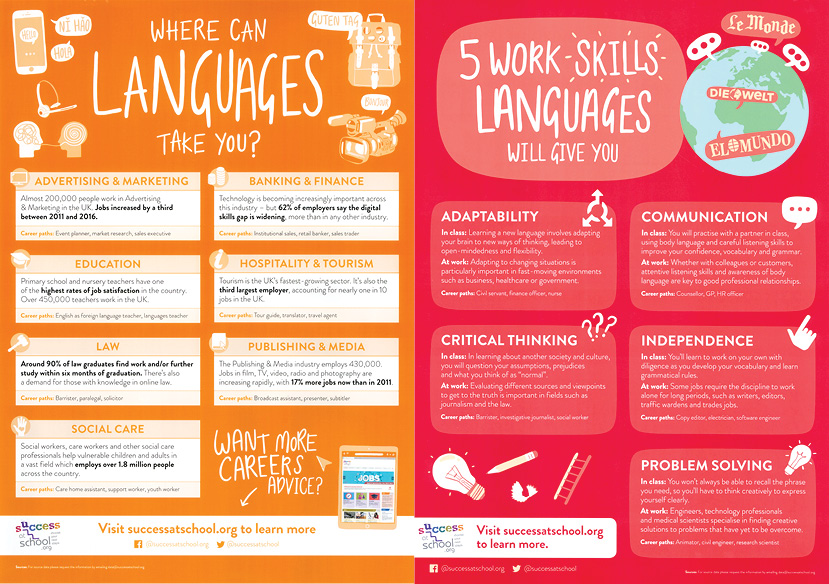
The French AS and A2 Level courses form a natural progression from GCSE, building on practical skills to enable you to understand and communicate in the written and spoken language for a variety of purposes in the world of work and leisure. Emphasis is placed on the development of personal and intellectual as well as linguistic skills.
What you will do
- Discuss topical issues such as the environment and racism, in French
- Read French newspapers and magazines
- Study a film and a book in detail
- Learn about current affairs and the French way of life from TV and radio
- Use the internet for information and communication
- Learn about French history and culture
- Speaking exam
- Reading, Writing and Listening exam.
Future prospects
An advanced language qualification is very highly regarded by employers, universities and colleges.
- Greatly enhanced employment possibilities throughout the increasingly global economy
- A range of study and career opportunities in fields such as Travel and Tourism, Education, Politics, Law, Journalism, Trade, Marketing and Publishing
- Communication and personal skills to benefit any future direction chosen.
SPANISH
Qualifications to start the course
Minimum entry requirements for all A Level courses are minimum of 8 GCSE subjects, with an average grade of 6 (legacy grade B) or above; including at least a grade 6 or above in GCSE English Language (or Literature) and GCSE mathematics and a grade 6 or above in GCSE Science.
In addition, to study this subject you must have a grade 6 or above in the chosen language (GCSE or equivalent).
Description of the subject
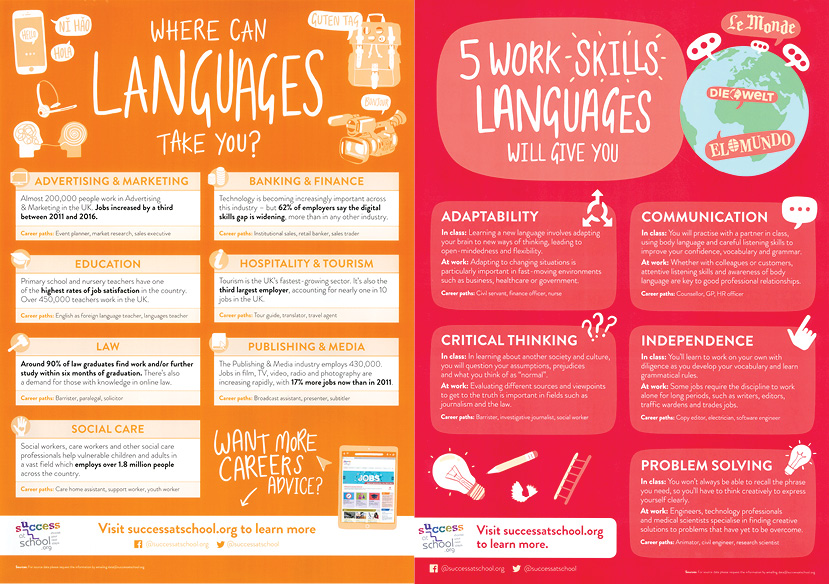
The Spanish AS and A2 Level courses form a natural progression from GCSE, building on practical skills to enable you to understand and communicate in the written and spoken language for a variety of purposes in the world of work and leisure. Emphasis is placed on the development of personal and intellectual as well as linguistic skills.
What you will do
- Discuss topical issues such as the environment and racism, in Spanish
- Read Spanish newspapers and magazines
- Study a book and a film
- Learn about current affairs and the Spanish way of life from TV and radio
- Use the internet for information and communication
- Learn about Spanish history and culture
- Speaking exam
- Reading, Writing and Listening exam.
Future prospects
An advanced language qualification is very highly regarded by employers, universities and colleges.
- Greatly enhanced employment possibilities throughout the increasingly global economy
- A range of study and career opportunities in fields such as Travel and Tourism, Education, Politics, Law, Journalism, Trade, Marketing and Publishing
- Communication and personal skills to benefit any future direction chosen.
Level 2 Courses
BUSINESS – BTEC First Certificate (Level 2)
Qualifications to start the course
General entry requirements for all Level 2 vocational courses are mainly D grades (grade 3/4) for at least 5 GCSE subjects.
Description of the subject
This is a vocationally related qualification. It provides knowledge of business activity and helps develop skills commonly required in business organisations.
This course suits young enthusiastic entrepreneurs that dream of setting up their own business: Equally this course suits mature thinking students who want to take a step closer to their career. Students will complete computer generated business reports, so many lessons will also be computer based. However, occassional role play and mock interviews also feature during the course.
Ultimately, this course is an exploration of how businesses work, particularly in finances and marketing; how you can set up a business; the importance of customer service; branding and sales. It also offers an inside track on how businesses recruit the best staff.
What you will do
Students will complete six units in one year (all units are 100% coursework which have to be both internally and externally assessed) and two online exams. The marking system comprises pass, merit or distinction. This is equivalent to 2 GCSEs at A* – C.
The 8 areas of study are:
- Enterprise in the Business world
- Finance for Business (online exam – maximum of three attempts with the best grade being accepted)
- Principles of customer service
- Recruitment, selection and employment
- Promoting a brand
- Principles of marketing (exam – maximum of two attempts)
- Sales and personal selling
- Introducing retail business
Future prospects
Careers in business, management and the ability to set up your own small private enterprise.
HEALTH AND CARE – Cambridge Technical (Level 2)
Qualifications to start the course
General entry requirements for all Level 2 vocational courses are mainly D grades (grade 3/4) for at least 5 GCSE subjects.
Description of the subject
The course covers caring for service users in a range of care settings and includes areas such as equality, effective communication, health and safety and cultural diversity. Students will be expected to complete assignments based on care settings and the workplace.
Health & Social Care looks at a wide range of care settings; residential homes, hospitals, nurseries and schools, and how to care for and treat people in these settings. This will allow students to develop the necessary skills for career progression in the health and social care sector.
What you will do
The course consists of eight units to be studied over one year, including four core units and four specialist units.
The core units include:
- Communication in Health and Social Care
- Individual Rights in Health and Social Care
- Individual Needs in Health and Social Care
- Ensuring Safe Environments in Health and Social care
All units are assessed through externally set assignments and coursework. There are no set external examinations.
Future prospects
Achievement of a Distinction or above allows students to progress onto Level 3 courses where applicable. Students may also choose to take up employment or further training to work in areas such as: Child Care, Care Assistant, Care Worker, and Education.
ENGLISH LANGUAGE – GCSE Mature
Qualifications to start the course
General entry requirements for all Level 2 vocational courses are mainly ‘D’ grades (grade 3/4) for at least 5 GCSE subjects.
Description of the subject
We have a proven track record of helping students achieve a ‘C’ (Grade 5) and above in English at Sir John Cass.
The aim of the course is to develop the students’ understanding of English Language. Students cover a range of fiction and non-fiction texts, as well as experiencing a range of teaching styles to help their understanding.
The course is specifically designed for students who have previously achieved a D (Grade 3) or equivalent and we have an experienced team dedicated to help students make the most of their potential.
Students taking the GCSE English Language Mature will have additional classes after school for at least one hour a week to develop their exam skills.
What you will do
- Develop your writing skills to ensure you can express yourself fluently for a range of purposes.
- Complete written assessments throughout the course to assess your progress.
- Complete two official examinations at the end of the one year course.
- Three speaking and listening assessments.
Future prospects
English Language at grade C (4 or above) is essential for gaining access to all courses in higher education.
Additional information
We currently use the AQA exam board and students will sit the English Language examination (New specification 2015 onwards).
Students sitting examinations in 2017 and beyond will achieve a Grade 1 to 9 (with 9 being the top) Students aim to achieve at least a Grade 4 and above in their English Language exam to be considered for most level 3 courses.
MATHEMATICS – GCSE Mature
Qualifications to start the course
General entry requirements for all Level 2 vocational courses are mainly ‘D’ grades (grade 3/4) for at least 5 GCSE subjects.
What you will do
- The GCSE Mathematics Resit course will follow the new Edexcel specification for Mathematics GCSE.
The new specification involves functional mathematics, problem solving and mathematical reasoning.
Topics include algebra, trigonometry, graphs, transformation, probability and statistics.
Future prospects
Mathematics at grade C (5) or above is essential for gaining access to all courses in higher education.
MATHEMATICS
/i/video/Maths-Sixth-Form-Open-Evening.mp4
Qualifications to start the course
Minimum entry requirements for all A Level courses are minimum of 8 GCSE subjects, with an average grade of 6 (legacy grade B) or above; including at least a grade 6 or above in GCSE English Language (or Literature) and GCSE mathematics and a grade 6 or above in GCSE Science.
In addition, to study this subject you must have a grade 7 or above in GCSE Mathematics. Students will also be expected to sit a Maths proficiency test to assess their suitability for the A-Level course.
What you will do
- The school offers a two-year Mathematics A Level course to students using the Edexcel exam board.
Students study the following options:
- The Advanced GCE in Mathematics (edexcel) consists of three externally – examined papers.
- Students must complete all assessment in May/June in year 13.
Future prospects
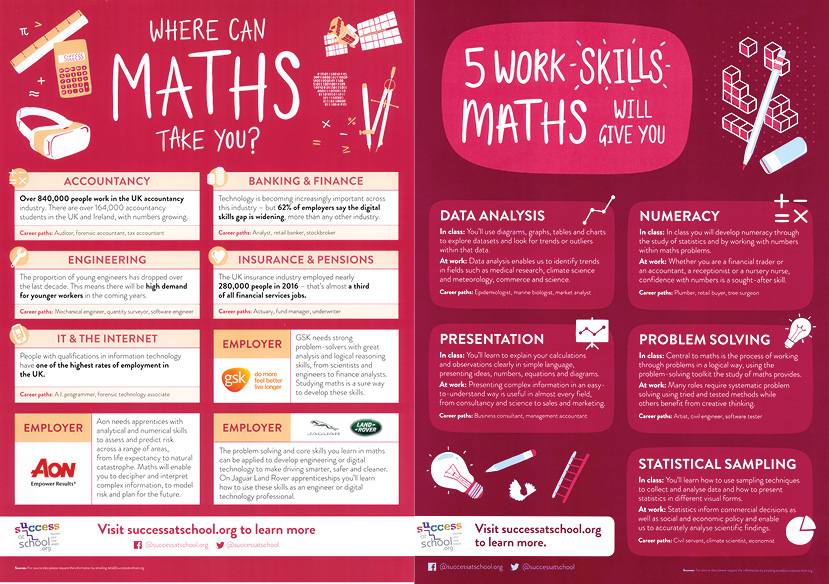
A Level Mathematics is considered to be good evidence of problem solving ability. Many courses in higher education require a competence in Mathematics but in areas such as Engineering, Economics and the Sciences, a qualification in Mathematics is a must.
Courses in Finance and Business Management are simply helped by a good A Level in Mathematics.
FURTHER MATHEMATICS
Qualifications to start the course
Minimum entry requirements for all A Level courses are minimum of 8 GCSE subjects, with an average grade of 6 (legacy grade B) or above; including at least a grade 6 or above in GCSE English Language (or Literature) and GCSE mathematics and a grade 6 or above in GCSE Science.
In addition, to study this subject you must have a grade 8 or 9 in GCSE Mathematics. Please be aware that A-Level Further Maths can only be chosen as a fourth A-Level option. Students must choose 3 other A-Level qualifications, one of which must be A-Level Mathematics. This will be reviewed at the end of Year 12 and students may be advised not to continue with Further Maths as a fourth option.
What you will do
- Further Mathematics consists of four papers.
- Students must complete all assessments in May/June in year 13.
Future prospects
A Level Further Mathematics gives students the opportunity to advance their mathematical knowledge beyond the scope of the A Level Maths Course. Students who wish to pursue a career in Civil Engineering, Electrical Engineering, Mechanical Engineering, Aerospace Engineering, Computing or Mathematics may find that a lot of the university content is covered in the Further Mathematics A Level course.
ECONOMICS - A LEVEL
Qualifications to start the course
Minimum entry requirements for all A-Level courses are a minimum of 8 GCSE subjects, with an average grade of 6 (legacy grade B) or above, including at least a grade 6 or above in GCSE English Language (or Literature) and GCSE mathematics and a grade 6 or above in GCSE Science.
To study this subject, you will also need a grade 6 or above in GCSE English Language and Maths.
Description of the subject
Economics is a wide ranging subject which touches on every aspect of commercial life.
As a result, study of Economics will broaden your understanding of the business, political and real world, encouraging you to evaluate some of the consequences of business and government decisions. Study of Economics is useful to those intending to enter the business and commercial world since it is included as a core subject in the examinations of all the professional bodies.
Economics is a difficult subject to summarise in a few lines and is probably unlike many of the subjects you will have studied at school. It is an academic subject which provides a good link between science and arts subjects. It is scientific in its investigative nature and requires good logical and analytical skills, together with the ability to produce convincing written argument.
If you study Economics you will discover, as with any subjects concerned with human behaviour, moral issues and that there is often more than one way of interpreting the observed facts. You will study the theories which try to explain economic behaviour, and will be free to weigh up the alternative arguments and draw your own conclusions.
The subject is ideal to study alongside Mathematics, Biology/Physics/Chemistry, Government & Politics, History, Sociology, Geography, Business and English. Economics is a subject that is intertwined with many A-Level subjects.
What you will do
During the Economics course you will consider issues such as:
- What are the effects of taxation policy?
- Why do political leaders always mention the economy?
- Why do exchange rates change and does a trade deficit matter?
- Is there enough money to go around? Some footballers earn in a week what a doctor, a person who saves lives, does in a year, why?
- Is it possible to reduce regional differences in unemployment?
- What influences the purchasing patterns of consumers and can a business predict these?
- Analysing public transport efficiency and ways to reduce road congestion.
- How can governments promote better care of the environment?
- What are the arguments for the cancellation of developing countries’ debt?
- What is the impact on the Eurozone in light of some member states’ budget deficits?
- The causes and consequences of globalisation.
Future prospects
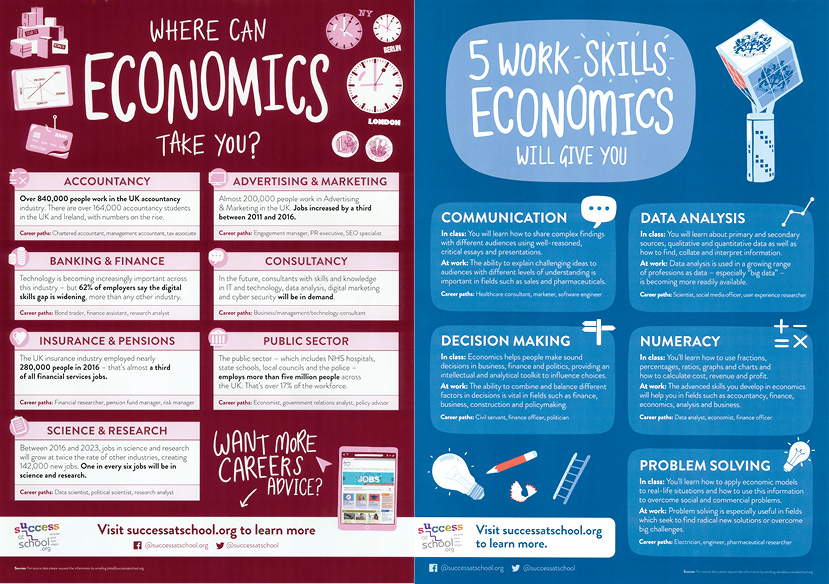
Economics students have excellent career opportunities open to them across a range of employment sectors. Some will choose to pursue a career as an economist, but many will enter other graduate roles in private and public sector organisations. Some of our SJC Economics alumni have gone on to become accountants, investment bankers and traders.
Just a few of the roles which can be pursued include:
Certified Accountant, Economist, Management Consultant, Finance & Investment Analyst, Investment Banker, Tax Consultant, Computer Programmer, Advertising and Marketing, Officer in The Armed Forces, Language Assistant.
GOVERNMENT AND POLITICS
Qualifications to start the course
Minimum entry requirements for all A Level courses are minimum of 8 GCSE subjects, with an average grade of 6 (legacy grade B) or above; including at least a grade 6 or above in GCSE English Language (or Literature) and GCSE mathematics and a grade 6 or above in GCSE Science.
In addition, to study this subject you must have a grade 6 or above in English Language.
Description of the subject
A Level Government and Politics provides an excellent introduction to the study of politics. It looks at how the UK is governed, both at home and within the context of the European Union, and considers the changing nature of the UK political system.
- Interested in learning how the country is governed?
- Intrigued by political systems and how they work?
What you will do
- Deepen your general understanding of politics and its significance in the modern world
- Think about and evaluate issues in a balanced and logical way
- Understand that politics is central to the developments and processes that are shaping our society and personal lives today
- Stimulate your interest in different areas of the subject.
- Develop the ability to interpret and apply evidence from different sources and reach appropriate and credible conclusions
- Encourage you to consider the strengths and limitations of different political systems, and how specific systems might be improved
- Demonstrate the importance of studying different perspectives in order to appreciate the complexity of issues and the difficulty of reaching definitive conclusions.
Future prospects
A variety of occupations in the fields of Politics, Education, Public and Civil Services and so forth.
LAW
Qualifications to start the course
Minimum entry requirements for all A Level courses are minimum of 8 GCSE subjects, with an average grade of 6 (legacy grade B) or above; including at least a grade 6 or above in GCSE English Language (or Literature) and GCSE mathematics and a grade 6 or above in GCSE Science.
In addition, to study this subject you must have a grade 6 or above in GCSE English Language.
Description of the subject
A level law will enable learners to develop an understanding of both public and private law within the law of England and Wales, and develop skills, which will prepare them for further undergraduate study and future careers. This subject will enable learners to develop their ability to analyse both legal rules and principles and factual issues and enable learners to construct persuasive legal arguments and to evaluate the strength of such arguments. It will also enable learners to develop the ability to think critically about the role of law in society.
What you will do
- Develop knowledge and understanding of the English legal system and areas of both private and public law within the law of England and Wales
- Develop an understanding of legal method and reasoning as used by lawyers and the judiciary
- Develop and apply the techniques of legal method and reasoning to analyse and offer answers to problems, based on legal principles, legislation and case law
- Develop the ability to construct conclusions and communicate legal arguments by reference to appropriate legal authorities
- develop the ability to communicate persuasive legal arguments by reference to appropriate legal authorities
- Demonstrate critical awareness of the influence and operation of the law in society.
Future prospects
A Level Law can lead to the study of Law at degree level which can lead to careers in the Legal Profession. However, A Level Law is not only for those who want to do a Law degree. It is a useful foundation for many university courses including Humanities, Social Sciences, Politics, Business and Management.
ScienceBIOLOGY
/i/video/A-level-Biology-compressed-6th-form-opening-evening.mp4
Qualifications to start the course
The entry requirements for all A-Level courses are a minimum of 8 GCSE subjects, with an average grade of 6 (legacy grade B) or above, including at least a grade 6 or above in GCSE English Language and GCSE mathematics and a grade 6 or above in GCSE Science.
Description of the subject
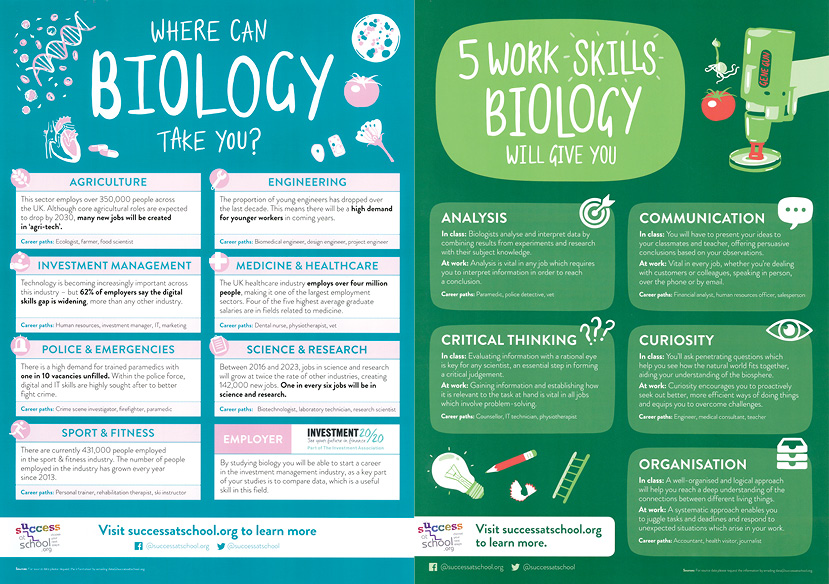
The Biology A level (Edexcel Salters-Nuffield) course is well structured and consists of 8 topics to be taken over 2 years. Students complete all termly assessments for both years. By the end of the second year, students will sit 3 examination papers. Practical work is an integral part throughout all the topics and students will also be assessed on the core practical skills as directed by the new specification.
- No re-sits are possible
- Students will have to pass the first year to qualify for the second year.
- Practicals will be assessed throughout the year
- Study guides and text books will be provided.
What you will do
The course consists of 8 Topics to be taken over 2 years:
- Topic 1: Lifestyle, Health and Risk
- Topic 2: Genes and Health
- Topic 3: Voice of the Genome
- Topic 4: Biodiversity and Natural Resources
- Topic 5: On the Wild Side
- Topic 6: Immunity, Infection and Forensics
- Topic 7: Run for your Life
- Topic 8: Grey Matter
There will be 3 exam papers and a Practical Endorsement:
- Paper 1: The Natural Environment and Species Survival (Topics 1 – 6)
- Paper 2: Energy, Exercise and Co-ordination (Topics 1 – 4, 7 and 8)
- Paper 3: General and Practical Applications in Biology (Topics 1 – 8 and review of scientific article released 8 weeks before examination)
- Practical Assessments: Write-up of at least 12 experiments over the course of 2 years
Future prospects
Previous students have embarked upon a wide range of careers including Medicine, Veterinary Science, Pharmacy, Physiotherapy, Environmental Science, Physiology, as well as careers in more broadly related areas such as the food industry.
CHEMISTRY
/i/video/Loom-_-Free-Screen-Video-Recording-Software-2.mp4
Qualifications to start the course
Minimum entry requirements for all A-Level courses are a minimum of 8 GCSE subjects, with an average grade of 6 (legacy grade B) or above, including at least a grade 6 or above in GCSE English Language (or Literature) and GCSE mathematics and a grade 6 or above in GCSE Science.
To study this subject, you will also need a grade 6 or above in GCSE Science and 6 in GCSE English Language and Maths.
Description of the subject
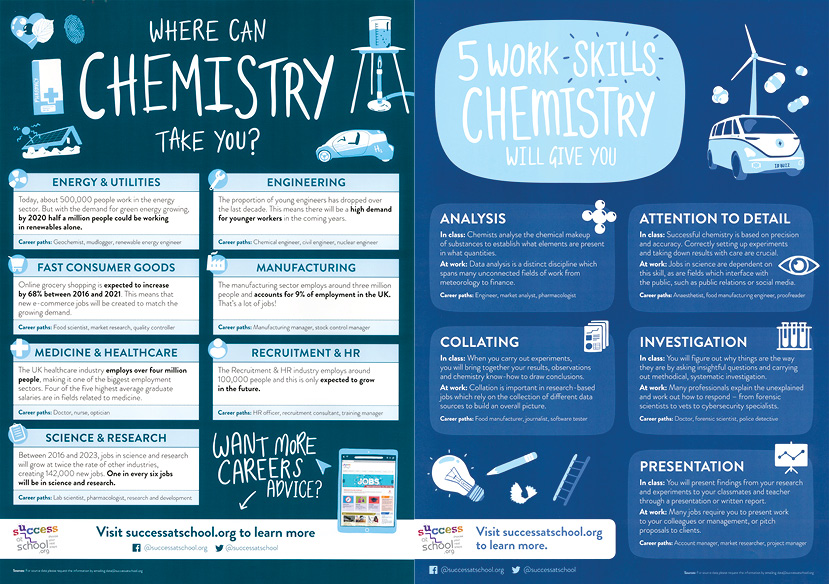
The OCR Chemistry A course covers the core chemistry required for the A Level student. It follows a content-led approach where the specification is divided into topics, each covering different key concepts of chemistry.
- No re-sits are possible
- Practical work will be assessed throughout the year
- Study guides and text books will be provided.
What you will do
The course consists of 6 modules to be taken over 2 years:
- Module 1: Development of Practical Skills in Chemistry
- Module 2: Foundations in Chemistry
- Module 3: Periodic Table and Energy
- Module 4: Core Organic Chemistry
- Module 5: Physical Chemistry and Transition Elements
- Module 6: Organic Chemistry and Analysis
There will be 3 exam papers and a Practical Endorsement:
- Paper 1: Periodic Table, Elements and Physical Chemistry (Modules 1, 2, 3 and 5)
- Paper 2: Synthesis and Analytical Techniques (Modules 1, 2, 4 and 6)
- Paper 3: Unified Chemistry (Modules 1 – 6)
- Practical Assessments: Write-up of numerous experiments over the course of 2 years
Future prospects
By studying two or more Science A Levels you will be open to hundreds of different Science degree courses at any one of the main UK universities, often with A Level entry requirements considerably lower than many other degree courses. Chemistry is the central science, combining as it does with Biology, Physics and Mathematics. A Science degree not only prepares you for a great diversity of careers within the field of science but also within the world of business and management.
PHYSICS
/i/video/Physics-Open-Evening.mp4
Qualifications to start the course
Minimum entry requirements for all A-Level courses are a minimum of 8 GCSE subjects, with an average grade of 6 (legacy grade B) or above, including at least a grade 6 or above in GCSE English Language (or Literature) and GCSE mathematics and a grade 6 or above in GCSE Science.
To study this subject, you will also need a grade 6 or above in GCSE Science and 6 in GCSE English Language and Maths.
Description of the subject
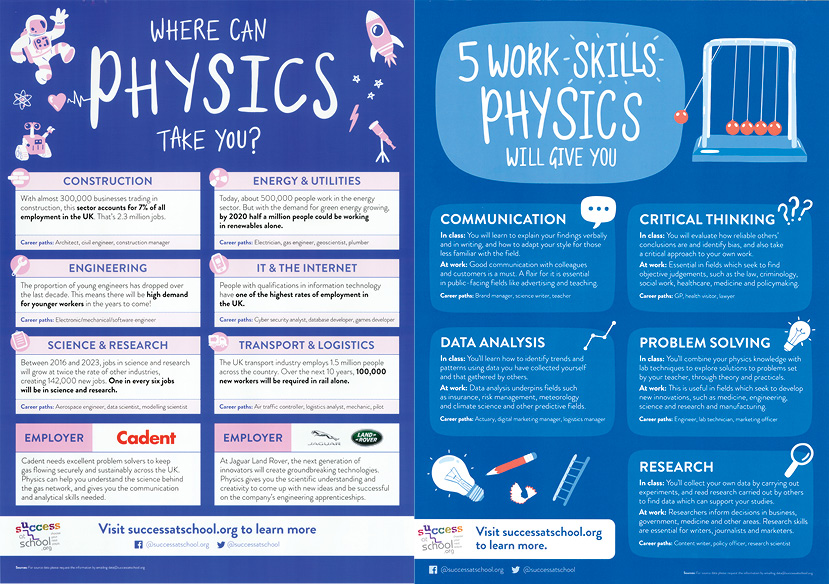
Physics provides an understanding of basic physical processes that form the basis of modern science, technology and engineering. It provides opportunities to apply the knowledge of physics to dealing with everyday problems.
The course is taught with the help of practical work designed to support your understanding of the concepts as well as the acquisition of laboratory skills. It also focuses on the idea of problem solving – a skill considered essential by many prospective employers.
- No re-sits are possible
- Practical skills and techniques will be assessed throughout the year
- Study guides and text books will be provided.
What you will do
Over the course of two years, you will gain the skill and understanding to complete 3 exams at the end of the course:
A Level Paper 1 – Advanced Physics I
- Working as a Physicist
- Mechanics
- Electric Circuits
- Further Mechanics
- Electric and Magnetic Fields
- Nuclear and Particle Physics
A Level Paper 2 – Advanced Physics II
- Working as a Physicist
- Materials
- Waves and Particle Nature of Light
- Thermodynamics
- Space
- Nuclear Radiation
- Gravitational Fields
- Oscillations
A Level Paper 3 – General and Practical Applications in Physics
- Questions will be drawn from any of the topics in Paper 1 and Paper 2
- Synoptic questions that draw from 2 or more of the topics in Paper 1 and Paper 2
- Questions that assess conceptual and theoretical understanding of experimental methods used for Science Practical Endorsement
A Level Science Practical Endorsement
- Write-up of at least 16 practical activities
- Common Practical Assessment Criteria (CPAC) to be met
- Minimum standard of practical techniques to be gained by candidates
Future prospects
By studying two or more Science A Levels, you will be opening up access to hundreds of different Science degree courses. Physics is a science, fundamental to the understanding of many other fields. A degree in Science not only prepares you for a range of careers within the science, but also within the world of business and management.
Physics graduate employment may include: Aeronautics, Engineering, Medical/Health Services, Geophysics, Optometry, Tele-communications, Actuarial Science, and Accounting. Mathematics is a must.
HEALTH AND SOCIAL CARE – BTEC Level 3
/i/video/compressed-OCR-Level-3-Health-and-Social-Care-Introduction_pptx-Google-Slides-Google-Chrome-1-December-2021.mp4
Qualifications to start the course
Students must have five GCSEs including English, Mathematics and Science graded A* – C.
Description of the subject
This course is taken in addition to the BTEC HSC Double Award. This course covers caring for service users in a range of care settings and includes areas of Science, Psychology and Sociology. Students will be expected to complete assignments based on care settings and the workplace. Health and Social Care looks at a wide range of care settings; residential homes, hospitals, nurseries and schools, and how to care for and treat people in these settings. This will allow students to develop the necessary skills for career progression in the health and social care sector.
What you will do
Year 12
Topics Covered/ Areas of Focus: At Level 3 the Edexcel BTEC Extended Diploma is offered to year 12 students. This course covers a range of different service users in a variety of care settings such as residential homes, hospitals, nurseries and schools. Students are expected to complete assignments based on care settings and the workplace. It will allow students to develop the necessary skills for career progression in the health and social care sectors. At level 3 students will gain knowledge of: human lifespan development, principles of safe practice, physiological disorders, equality and rights, human development, dementia, and nutritional health.
Year 13
Topics Covered/ Areas of Focus:
The OCR Cambridge Technical in Health and Social Care is in its final year. Students who have completed this course in year 12 will complete the remaining units in year 13. This course looks at a range of different service users in a variety of care settings such as residential homes, hospitals, nurseries and schools. Students are expected to complete assignments based on care settings and the workplace. It will allow students to develop the necessary skills for career progression in the health and social care sectors.
Students will gain knowledge of: careers in health and social care, psychology, sociology, nutrition, complementary therapies, anatomy and physiology, research methods and the psychology of ill health.
Future prospects
Achievement of a Level 3 course allows students to progress to higher education or training courses such as Nursing, Childcare and Early Years, Care Assistant, Care Worker, and Education.
PSYCHOLOGY
/i/video/261b1f7dc0144765a40cdc95ccbca991-1607515046677.mp4
Qualifications to start the course
Minimum entry requirements for all A Level courses are minimum of 8 GCSE subjects, with an average grade of 6 (legacy grade B) or above; including at least a grade 6 or above in GCSE English Language (or Literature) and GCSE mathematics and a grade 6 or above in GCSE Science.
In addition, to study this subject you must have a grade 6 or above in GCSE English Language and Mathematics.
Description of the subject
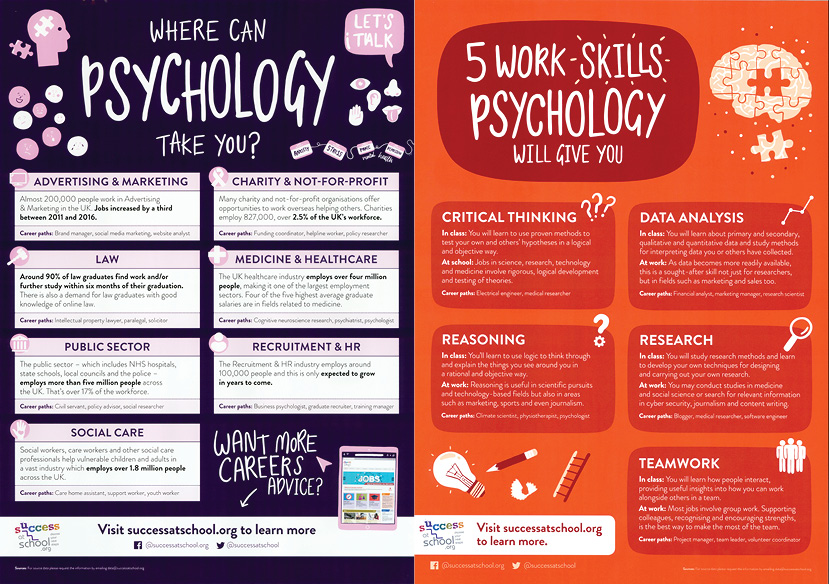
Psychology is the study of the mind and behaviour. You will explore issues dealing with how and why people behave in certain ways and what links people’s behaviour to the environment.
A-level Psychology is a two year linear course which consists of three externally assessed units incorporating a range of multiple choice, short answer and extended writing questions. External examinations will take place at the end of the second year covering all of the content. Internal examinations will take place at the end of year 12 to determine progression onto year 13.
What you will do
- Demonstrate knowledge and understanding of psychological concepts, theories, research studies, research methods and ethical issues
- Apply psychological knowledge and understanding content in a range of theoretical and practical contexts
- Analyse, interpret and evaluate psychological concepts, theories, research studies and research methods
- To make judgements and reach conclusions and develop and refine practical design and procedures.
- Evaluate therapies and treatments including in terms of their appropriateness and effectiveness.
- Develop knowledge and understanding of research methods, practical research skills and mathematical skills
- Design and conduct research, including the analysis and interpretation of data.
Year One Psychology includes:
Unit 1: Introductory Topics in Psychology:
- Social Influence
- Memory
- Attachment
- Psychopathology
Unit 2: Psychology in Context
- Approaches in psychology
- Biopsychology
- Research Methods (including data handling and analysis, scientific processes and inferential testing)
Year Two Psychology includes:
Unit 2: Psychology in Context (continuation from year 12)
- Approaches in psychology
- Research methods (including data handling and analysis, scientific processes and inferential testing)
Unit 3: Issues and options in psychology
- Issues and debates in psychology
- Gender
- Schizophrenia
- Forensic psychology
Future prospects
Following a degree course in any of the Social Sciences can lead to a career in Health and Social Care Services, Human Resources, Business Management, Education and Research, Prison Services, Civil Service, Forensic Services. In addition, there are several core fields students could enter following a degree course in Psychology: Clinical Psychology, Occupational Psychology, Forensic Psychology, Educational Psychology and Research.
SOCIOLOGY
/i/video/A-level-Sociology-Loom.mp4
Qualifications to start the course
Minimum entry requirements for all A Level courses are minimum of 8 GCSE subjects, with an average grade of 6 (legacy grade B) or above; including at least a grade 6 or above in GCSE English Language (or Literature) and GCSE mathematics and a grade 6 or above in GCSE Science.
In addition, to study this subject you must have a grade 6 or above in GCSE English Language.
Description of the subject
Sociology is the study of human interaction. The main concern is to explain human behaviour by examining individuals, small groups and institutions such as political organisations, the education system and the family. Sociology addresses ‘important’ questions such as: ‘Why do girls generally perform better than boys in education? Why are some people racist, sexist or homophobic?’, attempting to answer these by considering various sociological perspectives (Marxism, functionalism, feminism) and a wide range of current research and evidence. It gives a better understanding of society and new insight into the way human life is organised. Sociology enables people to make sense of their own experiences.
What you will do
| Components covered in the first year | Assessment overview |
|
Component 1: Socialisation, culture and identity
|
90 Marks 1hour 30 minutes written paper 30% of total Alevel |
|
Component 2: Researching and understanding social inequalities
|
105 Marks 2hour 15 minutes written paper 35% of total Alevel |
| Components covered in the second year; | Assessment overview |
|
Component Three:
|
105 Marks 2hours 15 minutes written paper 35% of total Alevel |
Future prospects
Sociology is recognised by all universities. It is a very popular and relevant subject for contemporary society. It is useful for most occupations (Politics, Law, Health & Social Care/Services, Education and the business world).